
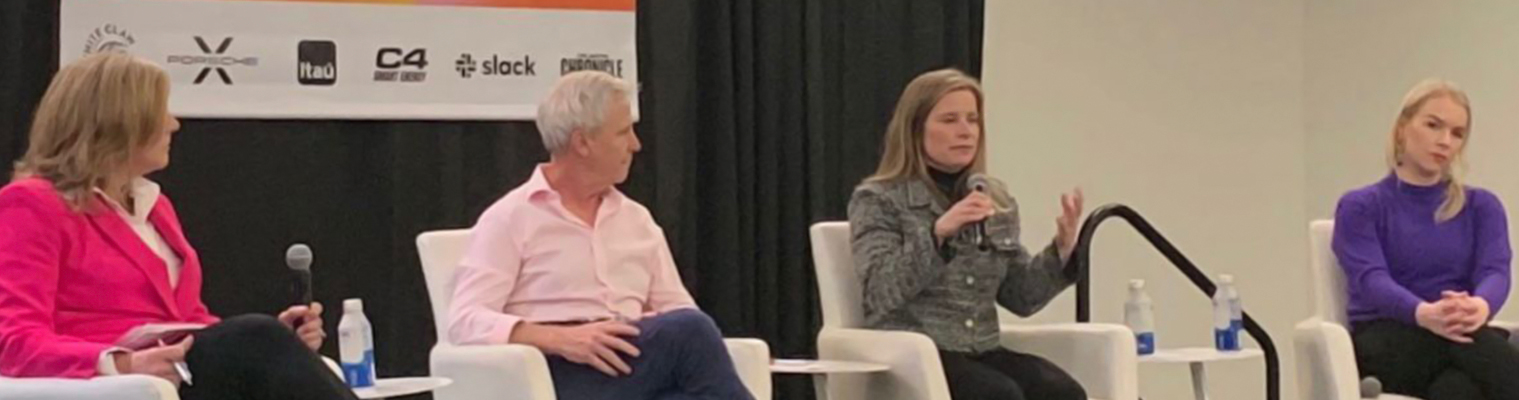
Urgency and scale set the tone for the sustainability debate at SXSW 2023, especially when the focus was on combating climate chaos.
During the panel “Climate Crisis vs. Consumer Culture: How to Change,” consultant Ashlee Piper _ author of the book that became the “bible” of sustainability in the US, “Give a Sh*t: Do Good, Live Better, Save the Planet” _ was emphatic in summing it up: “The planet is OUR stakeholder.” This statement had a strong impact on me, and I ended up hearing it again the following day from Patagonia CEO Ryan Gellert, whom I also discuss in this article.
Returning to Piper, she emphasized the need for companies to communicate more effectively what they are actually doing in sustainability, with greater clarity and consistency _ essential for brands to earn people’s trust, especially after the wave of irresponsible use of inappropriate or misleading terms such as “green” and “planet friendly.” Alongside her, Samsung’s Head of Corporate Sustainability, Mark Newton, added: “We need to talk more about why we’re doing things rather than simply telling people what we’re doing.”
Ashlee Piper also highlighted her belief “in individual behavior driving collective transformation.” In this sense, she sees initiatives promoted by companies to help people become engaged and make positive contributions in their daily lives as a step in the right direction _ such as apps launched by energy companies that allow people to monitor their daily consumption and carbon footprint.
Changing individual behavior was also addressed by Patagonia CEO Ryan Gellert, who took the main stage at SXSW in an interview brilliantly conducted by Katie Couric, an award-winning journalist and the first woman to anchor a television newscast alone in the United States.
“Think of yourself as an owner of what you buy, not as a consumer,” the executive said, after speaking at length about corporate responsibility for climate chaos. “We created the problems, and there’s no way to solve them unless companies take responsibility. As I tell my children: if you made the mess, clean it up,” Gellert said, receiving a standing ovation from the audience at that moment and on several other occasions throughout the panel.
The executive _ who joined the company in 2014 and has been CEO since 2020 _ discussed the company’s various initiatives, ranging from offering indefinite repair services for clothing sold in its stores and buying back used garments to creating a coalition with other apparel and footwear brands to seek more sustainable solutions for the entire industry and its supply chain. Going beyond its business and industry, the company donated vast areas of land in Chilean and Argentine Patagonia to conservation organizations in both countries and developed a river protection project in Albania.
And when asked by the journalist about individual behavior, about each one of us, Gellert expressed concern about the apathy he believes has taken hold of most people. “We’ve lost the right to be pessimistic, to sit back and say what can’t be done.” According to Patagonia’s CEO, “people matter, but they don’t know what to do.”
With this in mind, Gellert shared an interesting reflection on how to break out of this inertia. “What does the world need? What am I good at? What makes me happy? I believe it’s at this intersection that people can move forward,” the executive suggested, once again receiving prolonged applause.
But I couldn’t end this article without saying more about Katie Couric. The journalist is also co-founder of the “Stand Up to Cancer” initiative, which has raised more than US$700 million since 2008, funding research that has contributed to the development of nine therapies for treating the disease, all approved by the FDA, the US regulatory agency.
Katie, it seems, has found her intersection.
Something to think about!
Carina Almeida, CEO & Founder of Textual