

A recently released study by the Reuters Institute reveals interesting insights into the use of generative AI, perceptions of its impact on society, and its relationship with journalism in six countries — Argentina, Denmark, France, Japan, the United Kingdom, and the United States.
Although Brazil was not included in the survey, the findings are worth following, given the scale of the expected impact of generative AI on our lives.
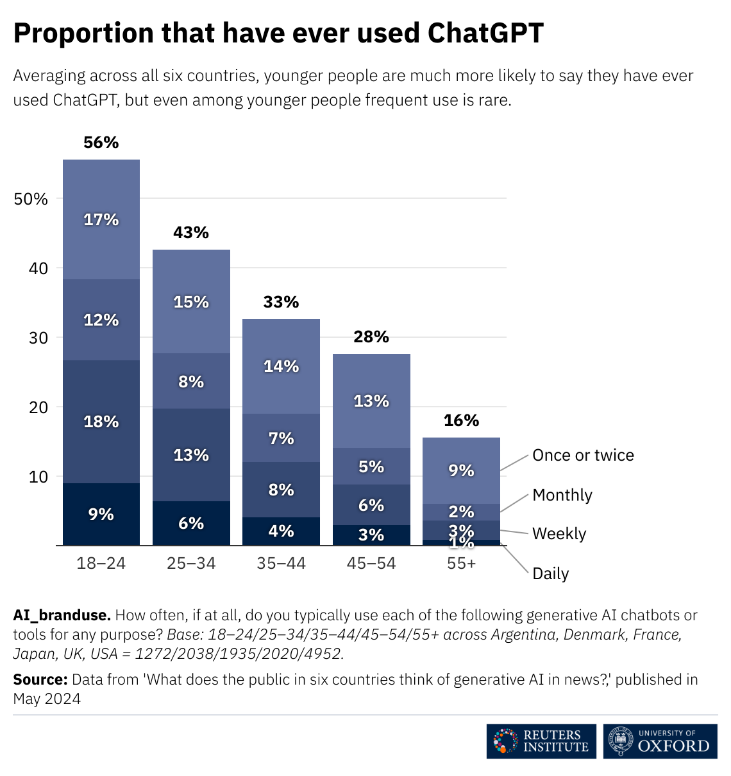
ChatGPT is the most widely recognized tool among people in the six countries, but its regular use remains quite limited. Daily use, for example, was reported by only 9% of young people aged 18 to 24, dropping to 1% among those over 55. Across all age groups, the most common response was having tried it “once or twice” — including 17% of young people under 24 and 13% of respondents aged 45 to 54.
The data suggests that most people use ChatGPT to create text, audio, and video content (28%) and obtain various types of information (24%). Only 5% of survey participants reported using AI to get the latest news.
At the other end of the spectrum, 19% of people in the United States and 30% in Japan have never heard of AI chatbots, despite both countries being home to major technology companies.
Impact on society
Most respondents believe generative AI will have a significant impact across all sectors of society over the next five years, ranging from 51% for political parties to 66% for both journalism and science.
However, there is no consensus on whether its impact on society will be more positive or negative. Many respondents preferred to say they were not yet able to assess it. Overall, optimism prevails when it comes to advances in science, medicine, and everyday activities, including entertainment. On the other hand, views become predominantly pessimistic regarding issues such as the cost of living, jobs, and news.
ChatGPT and Journalism
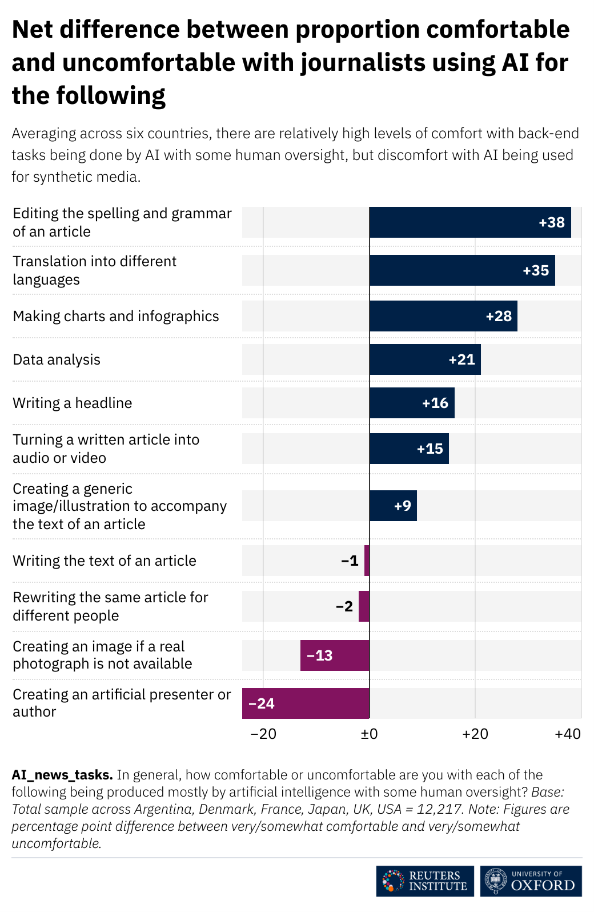
The survey also reveals some very interesting insights into people’s perceptions of journalism involving generative AI. In general, AI-generated journalism is perceived as less trustworthy, but also less costly for news organizations. People prefer news produced by humans, although they feel comfortable with AI being used for certain tasks.
According to the survey, a large proportion of respondents believe journalists are already using generative AI for spelling and grammar checks (43%) and headline writing (29%). Meanwhile, 27% believe the technology is already being used to write articles. Reinforcing the preference for human involvement, one-third of respondents believe editors always check content to ensure that errors are not published.
It’s important to highlight that younger people are more likely to feel comfortable with news produced entirely or partially by AI. In these cases, audiences tend to prefer its use in sections such as fashion and sports rather than those covering topics such as politics. Even so, using AI to generate an image when a real photograph is unavailable, or to create virtual news presenters, is generally viewed with discomfort.
And is AI-generated news worth paying for? For 41% of survey participants, the answer is “no,” because they believe it will be less valuable than news produced by humans. Finding the right balance in using AI to increase efficiency without compromising credibility, therefore, appears to be the new challenge for news organizations.
The full study is available here: What does the public in six countries think of generative AI in news? | Reuters Institute for the Study of Journalism (ox.ac.uk)
The survey was conducted between March and April of this year, with approximately 2,000 respondents in each of the six countries.
Carina Almeida, Managing Partner at Textual