

For three days, Cidade das Artes, in Barra da Tijuca, was occupied by thousands of favela residents. And they came from many places. From Chapéu Mangueira, Rocinha, Alemão, Complexo da Maré, Complexo da Penha, Senador Camará, Vila Kennedy, Chapadão, Cachoeiras de Macacu, Cubango… The spaces of this enormous municipal cultural complex were literally taken over by the favela. But unlike what these residents are used to when police enter their communities with armored vehicles and rifles, this was a positive occupation. Instead of weapons, residents brought plenty of peace and joy. A lesson in citizenship and diversity, as they explored the Rio de Janeiro edition of Expo Favela Innovation.
Organized by Favela Holding, the event’s central message is that, rather than being defined by deprivation, favelas are places of potential. The event was conceived by Celso Athayde, one of the founders of CUFA and CEO of Favela Holding. Expo Favela has a traveling program and will visit several cities across the country. It began in São Paulo last year and arrived in Rio after visiting four other cities. It is already considered Latin America’s largest entrepreneurship fair for the fourth sector.
Between the favela and the formal city
There were three days of talks that brought together two worlds: the communities and the formal city. Among the speakers representing the formal city were artists, journalists, authors, politicians, and researchers. Representing the favelas were leading figures from CUFA, AfroReggae, Voz das Comunidades, and Notícia Preta. There was a bit of everything. Talks, conferences, a book fair, games, spaces for children, and, at the end of each day, samba and pagode performances and plenty of fun. After all, everyone deserves a break.
The potential of the favelas was translated into numbers presented by Renato Meirelles, president of Instituto Locomotiva and founder of DataFavela.
According to the study, Brazil has more than 13,000 communities, home to 17.9 million people. If the favelas were a country, their population would be similar to Chile’s and larger than those of countries such as the Netherlands, Belgium, or Bolivia. A consumer market worth R$31 billion. In Rio de Janeiro, one in ten residents lives in a favela. And despite living in a coastal city, 53% have never been to the beach. Safety (31%) and Respect (15%) are among their priorities.
In the conference rooms, panels discussed solutions for favela residents, drawing on the experiences of people who move between both worlds. Journalist Flávia Oliveira, a Black woman from the working-class neighborhood of Irajá and now one of Brazil’s most respected communicators, spoke about her life experience. “I studied communication and have some knowledge of economics. If I didn’t use that to help those who need it, I wouldn’t be fulfilling my role properly.” She argues that entrepreneurship in underserved communities should be treated in the same way as startup incubators, which receive millions of reais to help their projects grow.
Flávia shared the panel with Silvio de Almeida, Minister of Human Rights. “Being an intellectual is only a problem when you’re Black.” “When we talk about entrepreneurship, what are we talking about, my friend? The future. Talking about the future, about people’s ability to envision a future, to imagine a new life, a better life for their own families.”
Thais Bernardes, editor-in-chief of Notícia Preta _ an anti-racist journalism platform with more than 400,000 Instagram followers _ interviewed Pedro Bial from TV Globo. Completely at ease and displaying the stage presence of a veteran, Thais discussed the defining moments of Bial’s career, from the collapse of the Soviet Union to hosting Big Brother. She also spoke a little about Notícia Preta. “Of our readers, 42% are white. We’re not a platform exclusively for Black people. And we produce news reporting.” The daughter of adoptive parents, Thais is an example of how far young people from underserved communities can go when given opportunities. She entered Uerj through its affirmative action quota system, received a scholarship, and spent almost ten years in Paris, where she began her professional career as a reporter for France’s leading public television channel and the country’s second most-watched channel. She returned to Brazil after her father’s death and created Notícia Preta, now a successful outlet among favela media.
The potential of the favela in practice
Outside the conference rooms, in the communal spaces of Cidade das Artes, it was possible to see how the potential of the favela works in practice. Small stands were set up so entrepreneurs could showcase their projects and talk a little about them. And recalling Flávia Oliveira’s comment at the beginning of this article about entrepreneurship in underserved communities, there was proof of why it deserves to be treated like a startup. Renato Meirelles, who presented the DataFavela study, reinforces this point.
“The favela invented the startup. Because in the favela, if you don’t innovate, you don’t survive. Innovating in the favela means building bridges.”
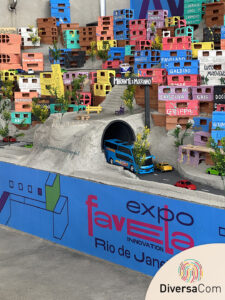
And to address the challenges faced by people living in places where so much is lacking, favela residents are coming up with innovative solutions in every direction. There are creative projects involving employment agencies, virtual assistants, distance learning, drawing workshops, vocational training, transportation, delivery services, solar energy, fashion, and communication.
Examples include the couple Rogério Márcio and Queli Cristina, who, after finding themselves unemployed and needing to support an autistic child, decided to clean people’s homes. Faced with the difficulty of finding people who needed their services, they created the Eu Facilito platform. They began registering people interested in working as cleaners on one side and homeowners or businesses needing cleaning services on the other. Today, they already have more than 20 people registered, as well as homes in several neighborhoods across Rio.
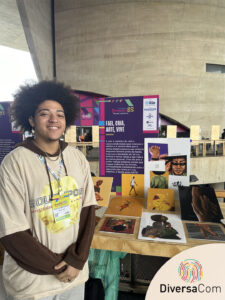
Rafael dos Santos, known as Fael, refused to let the lack of a computer stop him from bringing his digital drawings to life. Using a drawing app downloaded onto his phone, he turned his own finger into a paintbrush and creates paintings depicting life in the favelas. He calls his artistic movement crialismo. “In the future, just as there was the Renaissance, this movement will be known as crialismo,” he predicts. Fael is from Senador Camará and wants to teach his technique to children in the favela. “Fael, Cria, Arte Vive is my project,” he says.
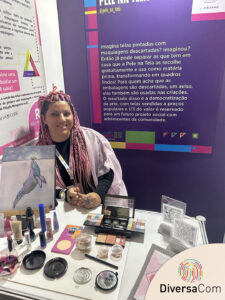
May Ramasine lost everything as a child and moved with her mother to Morro do Cubango, in Niterói. Accustomed to having new notebooks with beautiful covers every year, her mother, now without money, began creating drawings using leftover makeup to decorate her daughters’ notebook covers. Now older, May has created the Pele na Tela project, which uses everything from leftover lipstick to face powder to produce paintings that would look right at home in any art gallery in Rio’s South Zone. And in addition to selling her artwork, May is holding workshops to teach children the technique so they can decorate their own notebooks. “All this makeup would have been thrown away. Today, it becomes art, and I also make sure the materials are properly recycled.” What would have ended up in the trash is now art and a source of income for her.
Anyone who lives in a favela knows that motorcycle taxis are now the main means of transportation. But if you’re outside the favela and need an Uber or taxi, it can be difficult to find a driver willing to accept the ride. That was the starting point for coworkers Erinaldo Junior and Gabriel Paiva to create Bimp, an app for motorcycle taxi drivers serving the favelas. They already have more than 400 drivers registered. “And we also provide delivery services. Someone buys something inside the favela and receives it from a motorcycle taxi driver who also lives in the community.”
May the favela continue to thrive!
Now let’s imagine if half of these projects were implemented. There is still so much that needs to be done in the favelas, but if it depends on the people who live there, they will become better places to live every day. “I always say that the favela is not defined by deprivation; it is defined by its potential. And the favela hasn’t simply overcome adversity; it continues to overcome it. Man, I don’t want to cry. But just making it here is already a victory,” celebrates entrepreneur Antony Bené. And may it keep winning!
Marcelo Moreira, managing partner at DiversaCom