
We had the honor of working with Pelé on at least seven occasions throughout Textual’s 27-year history. Each time, we witnessed what the world has been celebrating over the past few days: how kind, helpful, and attentive he was to everyone, in addition to being a football genius. He calmly and graciously made time for everyone, always insisting that he didn’t need additional security, even when he found himself literally surrounded by fans eager to spend a moment with him.
I’d like to highlight three experiences with him that perfectly illustrate the King’s character, humility, and professionalism, even off the pitch.
Beijing, 2008, during the Olympic Games. As part of the promotional agenda for Rio’s bid to host the 2016 Olympics, for which we were responsible for communications, Pelé was scheduled to visit the inner area of the Olympic Village, where athletes and coaches live during the Games. It is a highly restricted area, with no access for the public or the press. The idea was for the King to walk through the area and visit the Village Mayor. We are talking, therefore, about a place inhabited by the world’s best athletes from many different sports, most of whom were accustomed to dealing with the stars of their own fields. But with Pelé, it was different. The Village literally came to a standstill. Athletes of all ages, from different countries, approached him to speak with him. Even the usually reserved Chinese volunteers lost their composure and joined the King’s walk, which became a sensation. One of the Games organizers told us they would call in additional security, but the King was categorical: “There’s no need.” And he continued stopping for photos and autographs with everyone, on a walk that, of course, lasted twice as long as planned.
One year later: Copenhagen, 2009, the week of the election of the host city for the 2016 Olympic Games. I was in the Danish capital with our team, developing a visibility agenda around Rio’s bid, which, of course, included Pelé. One of the activities would take place at a small school in the city, attended mainly by children of immigrants. Pelé would take the opening kick of a football match between school teams on a concrete court. A simple moment, full of symbolism, reinforcing the magic of sport and its ability to bring people together and promote integration. What was remarkable was that news of the King’s presence at the small school spread throughout the neighborhood, and children began arriving with their mothers or fathers from every direction, all in a frenzy to meet the King.
How could that be? Young children living in Denmark, going wild and shouting Pelé’s name in their different accents? Yes, that’s exactly what happened. We Brazilians have always known that Pelé was global, long before the world became globalized. But those young children, with their eyes shining as they shouted the King’s name, left me astonished and deeply moved.
And the King? Completely relaxed, he took the opening kick as planned and almost stayed to play, had we not asked him to stop there, because we knew how challenging it would be to get him from the enclosed court to the car. With his usual warmth and composure, he spoke to, hugged, and took pictures with every child, every father, and every mother who surrounded him. And a wall of photographers and camera crews from around the world captured that magical moment.
The third episode: Rio de Janeiro, 2001, during the press conference announcing Coca-Cola’s partnership with the King, when the launch of an advertising campaign and an exhibition in São Paulo would be announced. In the VIP room, I greeted Pelé and made myself available, and he was the one who asked for details about the event and which messages we would like him to emphasize. Well, once again, I could see: the King really was different. We exchanged a few ideas, and I warned him that the sports press would probably ask him during the press conference about that day’s news concerning uncertainty over Romário’s selection for the Brazilian national team. “Well, if they ask me, I’ll say that if I were the coach, Romário would always be on my team.” He thanked me for the “heads-up,” and it was precisely that answer, given by Pelé to a reporter, that propelled the Coca-Cola partnership announcement into headlines across the media.
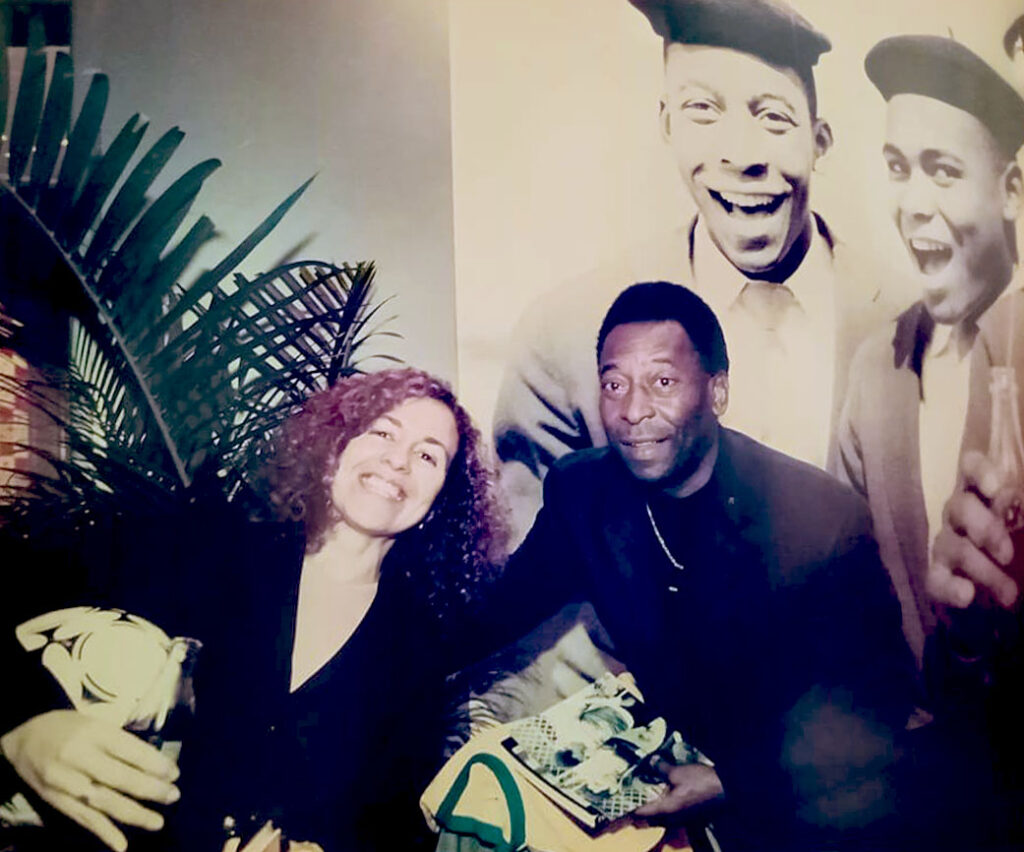
There were other magical moments and many opportunities to learn from Pelé, including in 2010, 2014, and 2016.
Thank you, Pelé. You are eternal.
Long live our King!
Carina Almeida, CEO of Textual