

The exclusive “Conversations That Build Reputation” survey by Textual Comunicação, developed in partnership with BALT Pesquisa e Consultoria, reveals that 77% of people believe brands that explain how they plan to reduce their environmental impact are more trustworthy. In a landscape marked by false information, declining public trust, and misinformation — identified as one of the leading global risks in the Global Risks Report released in January at the World Economic Forum — the way companies communicate progress on their environmental, social, and governance commitments is no longer a peripheral issue. It has become a strategic priority.
Click here to download the full survey.
The study identifies a new grammar of trust in Brazil, built around three clear pillars: transparency, usefulness, and authenticity. More than inspirational narratives, people expect clarity, evidence, and consistency between what brands say and what they actually do. In this context, ESG — already increasingly integrated into financial reporting and influencing companies’ strategic direction and impact — is becoming an objective criterion through which society evaluates brands.
Combining qualitative and quantitative research, the study surveyed 600 people across all regions of Brazil, gathering insights that help map how Brazilians build trust and interpret the role of brands in their everyday lives.
Among its findings, sustainability ranks as the third most requested topic, cited by 29% of Brazilians, behind more universal subjects such as health and topics less likely to raise questions about authenticity, such as innovation and technology. Sustainability is actively sought by a minority (29%), but rejected by only 7%, leaving 64% in a neutral position — they do not actively ask for it, but are receptive to it. At the same time, 77% believe brands that explain step by step how they plan to reduce their environmental impact are more trustworthy.
“ESG has become an infrastructure of trust. Brands are increasingly evaluated on their ability to explain processes, demonstrate consistency, and provide reliable information, effectively becoming sources of validation in their relationship with society. Understanding this reinforces our purpose of fostering genuine connections between companies and society, driving meaningful transformation,” says Carina Almeida, Founding Partner of Textual.
Given the complexity of today’s information environment, the survey shows that ESG consistently emerges as a criterion for evaluating trust, rather than simply as a desirable communications topic. Across all ESG pillars, there is a clear distinction between wanting brands to talk about an issue and actually trusting them more when they demonstrate action and explain what they are doing. In other words, it cannot be just a narrative.
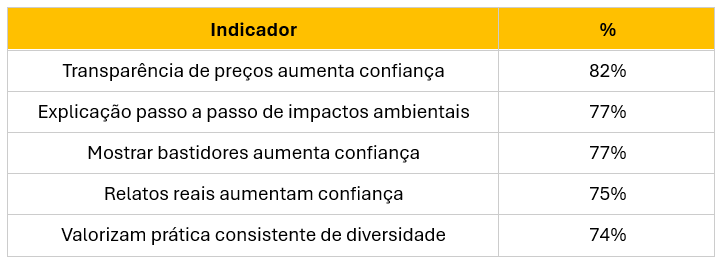
While 29% want brands to talk about sustainability, 77% trust them more when they explain, step by step, how they will reduce their environmental impact. The finding suggests a growing demand for technical clarity, measurable targets, and concrete evidence rather than generic messaging.
Within the social pillar, the survey reveals an expanded role for companies: acting as mediators of reliable information in an increasingly complex information environment. The public expects companies not only to take a position, but also to organize, curate, and translate information — behaviors that are increasingly expected of brands. In fact, 86% of people expect brands to help combat misinformation, while 85% expect them to help people understand what is happening in the world.
Today’s environment calls for communications grounded in transparency and verifiable data, without losing the power to inspire and reach broader audiences. We need to understand what companies and organizations are doing, what their ESG commitments are, and what impact they are generating — and help them tell those stories in an accessible and engaging way.
After all, ESG is present in people’s everyday lives, often without them even realizing it, and brands have both the power and the resources to drive meaningful change. It is not simply about communicating actions, but about creating value for businesses and society while strengthening reputation and trust.
More news about ESG and DiversaCom
An African King and the Paris Olympics Earn Awards for DiversaCom
Diversity and Inclusion: Highlights and Challenges at Rio Innovation Week 2023
Karla Rondon Prado, Director of Client Services and ESG at Textual and DiversaCom